Resume Contact Details for Remote Applications: Give Employers What They Need
For a remote application, use a professional email address and at least one reliable way for an employer to reach you. Add a city, region, or country only when it clarifies eligibility, work location, or availability; a full street address is usually unnecessary unless the posting or application asks for it. Follow the employer’s instructions first.

Start with the employer’s instructions, then choose the minimum useful details
The best default is a working email address, a dependable contact method, and only the location information that helps the employer understand your application. But a clear instruction from the employer takes priority. If the posting or application asks for a mailing address, city, country, time zone, or another location detail, provide it accurately in the requested place.
Remote work changes where you perform the job. It does not remove every location requirement. A role described as remote may be limited to a country, state, province, or hiring region. It may also require a particular time-zone overlap, occasional office visits, or eligibility to work in a defined jurisdiction. Your resume contact line can clarify relevant facts, but it cannot replace an application question or establish eligibility by implication.
A hiring team may ask for a full address for a specific administrative or screening reason. That is the strongest exception to omitting a street address: when the instructions request it, follow them. Otherwise, do not add a detailed address simply because an old resume example shows one. The University of Pennsylvania Career Services recommends a header with a name, email, and phone number, and says a full street address is not needed; city and state or country can be included. Its advice is general career guidance, not a universal rule for every country, employer, or application. University of Pennsylvania Career Services
Use this decision order:
- Read the job posting and application form for explicit contact or location instructions.
- Identify any location condition that could affect your ability to do the job, such as a stated hiring region or required time-zone overlap.
- Include the contact method you reliably monitor and any location detail that answers that condition.
- Leave out personal location data that adds no useful information, especially a street address the employer has not requested.
- Check that the resume and application answers tell the same accurate story.
This order prevents two opposite mistakes. One is giving away more personal information than the application needs. The other is withholding a location fact that the employer explicitly asked for or that would prevent a basic misunderstanding.
Decision table: which contact details belong on the resume?
Use the table as a default for an ordinary remote-job resume. The posting and application still govern. Practices differ by employer, occupation, and country, so treat the table as a decision aid rather than a mandatory format.
| Detail | Best default | Include it when | Leave it out when |
|---|---|---|---|
| Full street address | Usually omit it | The posting, form, or a specific process expressly requests it, or there is a clear practical reason to supply it | No instruction calls for it and a city or region is enough to explain your situation |
| City or metro area | Optional | It clarifies a stated local hiring area, office proximity, relocation plan, or other relevant context | It does not help answer a role requirement and you prefer not to disclose it |
| State, province, or region | Optional; often useful when location eligibility is regional | The employer limits hiring by state, province, or region, or the location distinction matters | The role is location-independent and the detail adds nothing |
| Country | Optional; include when relevant | The employer restricts hiring by country, asks where you are based, or the detail helps explain a cross-border application | It is irrelevant to the posting and already clear elsewhere in the application |
| Phone number | Usually include one reliable number if you can receive calls or messages on it | You can monitor it, control voicemail access, and respond within a reasonable time | You cannot reliably receive calls there and another clearly labeled contact method works better |
| Email address | Include one professional address you check regularly | Nearly every ordinary application needs a reliable written contact route | Rarely; omit only if the employer gives a different required method and the resume is not being used as a standalone document |
| Time zone or availability window | Optional, not a substitute for contact details | The role specifies overlap hours, the employer requests availability, or your time zone could otherwise cause avoidable scheduling confusion | No relevant time-zone requirement exists or the application already asks and records it clearly |
| Relocation or work-location note | Include only if accurate and useful | You are genuinely willing to relocate, travel, or work from a stated location and this answers a condition | You are guessing what the employer wants, or the note would imply a commitment you have not made |
Career-service advice illustrates why this is a judgment call. Penn’s guidance says a full street address is unnecessary and allows a city and state or country. The University of Minnesota’s Career Services guidance describes an address as optional and says an applicant choosing to include one may provide a full or partial address, such as city and state. That variation supports a practical conclusion: there is no single contact header that fits every applicant, but a street address is not automatically required on every resume. University of Pennsylvania Career Services · University of Minnesota Career Services, “Resume Content”
The table does not tell you to hide your location. It asks you to match each detail to a purpose. If a city answers a hiring-region question, include it. If it is just a precise marker of where you sleep, with no bearing on the role, leave it off unless requested.
Full address: when a street and postal code help, and when they do not
A full street address is usually the least useful item in a remote resume header. It tells the reader more precisely where you live, but precision is not automatically useful. If the employer only needs to know whether you are in an eligible country or region, a city or country may answer that question with less personal detail.
A full address can be appropriate when an application expressly asks for it. In that case, give the requested information accurately in the application field. If the resume itself must contain it, add it there too. Do not substitute an approximate or misleading address, and do not use a relative’s address as if it were your own current residence.
A full address may also be useful in a narrower case where a specific process genuinely depends on it. The employer might be collecting a mailing address for a stated reason, or a role may require proximity to a particular facility despite being mostly remote. If the reason is unclear, use the application’s designated fields and ask the employer’s recruiting contact if the request creates a meaningful privacy or accuracy concern. Do not assume that the resume header is the only place the address can go.
For most remote applications, a street address creates avoidable tradeoffs:
- It exposes a more precise home location than a city or region.
- It takes space that could be used for experience or skills.
- It can become inaccurate after a move.
- It can invite confusion if it differs from a location entered in the form.
- It may imply local availability when you are not actually available for onsite work.
These are reasons to omit an unrequested address, not reasons to refuse every request for one. Follow clear instructions. If you have a concern about providing it, contact the employer rather than inventing a workaround.
Hypothetical example: An applicant lives in a small town and applies for a remote role restricted to residents of a particular state. The application asks which state they live in, but not for a street address. The resume header can say “Town, State” or simply “State,” depending on what provides useful context. The form gets the exact response requested. The applicant does not need to add a house number to answer a state-level requirement.
If the application asks for a mailing address, the applicant should distinguish mailing address from current work location if the form offers separate fields. A mailing address may not establish where the person will perform the job. Use the form’s labels, and ask for clarification if it combines concepts that matter to eligibility.
City, region, and country: choose the right level of location detail
Location is not one all-or-nothing field. A city, region, and country answer different questions. Choose the narrowest level that resolves a real issue in the posting, and avoid suggesting facts that are not true.
A city can answer whether you are near an office, within a local hiring area, or already in a place where occasional onsite work is possible. A state or province can answer a regional hiring restriction. A country can clarify cross-border eligibility or where you are based. If none of these facts matters to the role, a location line may be unnecessary.
A location line can also create an unintended signal. “Berlin, Germany” may be read as where you currently live. “Open to relocate to Berlin” says something different: it describes a willingness, not current residence. Do not collapse those statements into a single city name.
Use the following distinctions:
- Current location: Where you are actually based now. Use it only if you want to disclose it or it helps explain a requirement.
- Target location: Where you hope to work. Label it as a preference, not as your present address.
- Relocation intent: A truthful statement that you are willing to move. Do not imply you have moved already.
- Work location: Where the job permits or expects you to perform work. This may differ from your residence and may be governed by the posting or employer policy.
- Mailing address: Where the employer can send correspondence. It is not necessarily the same as current residence or authorized work location.
Hypothetical example: An applicant currently lives in Porto and sees a remote posting that says candidates must reside in Portugal. “Portugal” answers the relevant geographic question without suggesting the applicant is in Lisbon. If the employer asks for a municipality or full address in the application, the applicant answers there accurately. The resume does not need to repeat every field from the form.
Hypothetical example: An applicant in a different country is willing to relocate, but has not made arrangements and does not know whether relocation support exists. Listing the destination city without a label could imply current residence. Better options are to omit the destination from the contact line or write a truthful, concise note elsewhere, such as “Open to relocation to [city], subject to role requirements.” The bracketed city here is a placeholder, not a real candidate detail.
Be precise about what a resume can and cannot establish. A location line may reduce confusion, but it does not prove work authorization, tax status, or eligibility to be hired in a particular jurisdiction. Answer those questions in the application as asked. If you are unsure what a legal or work-authorization question means, seek qualified guidance rather than using the contact header to imply an answer.
Phone: include a number you can actually answer
A phone number is useful only if it reliably reaches you. Include a number you monitor, can receive calls on, and are comfortable using for recruiting contact. If you often miss unknown calls, make sure the voicemail greeting is professional and gives the caller a way to leave a message. Check that the mailbox is not full.
A remote role does not make a phone number automatically irrelevant. An employer may use email, a phone call, or a scheduling system. But your resume does not need multiple numbers to prove availability. One dependable number is usually clearer than a home number, mobile number, and secondary number with no explanation.
If you use a number with an international country code, format it so a reader can identify the code and number without guessing. Keep the format consistent with the country where the number operates. Avoid adding a country code that does not belong to the number simply to make it appear local to the employer.
If phone access is difficult, do not list a number that cannot receive messages. Use an email address you check, and follow the application’s contact preferences. If an employer requires a telephone number and you cannot provide one, ask whether another method is acceptable. Do not quietly leave a required field blank if the form provides a clear instruction.
Hypothetical example: An applicant is temporarily traveling and has a home-country number that still receives calls only when roaming is enabled. If roaming is unreliable or costly, listing it as the only contact route may lead to missed calls. The applicant should choose an accessible number if they have one, verify that it works, or make email the most visible route while answering any required phone field accurately.
A phone number also creates a privacy tradeoff. If you are concerned about sharing a personal number, consider whether you have a separate number or service you can reliably maintain and use for job applications. Do not list a temporary number that you may abandon before the hiring process ends. Whatever number you choose, keep it under your control and check it during the period when you expect employers to respond.

Email: one professional inbox beats several stale addresses
Include one professional email address that you check frequently. It should be easy to read and type. A variation of your name is usually enough. Avoid an address that looks like a joke, contains an old school or employer identity you no longer control, or is so complicated that a recruiter might mistype it.
You do not need to create a new address for every application. A separate job-search inbox can help you organize messages, but only if you monitor it. An inbox that looks polished and sits unread is worse than a plain address you check every day.
Before you apply, test the address from another account or send yourself a message. Confirm that:
- You can sign in from the device you will use during the search.
- The mailbox has room for incoming mail.
- Messages from unfamiliar senders do not disappear into a folder you never check.
- Your display name is appropriate and recognizable.
- The address in the resume exactly matches the one in the application.
A professional email address does not need to be elaborate. It needs to be readable, controlled by you, and monitored. If your current address is tied to a school or employer that may close your access, set up a durable alternative before relying on it for a job search.
Remote hiring can involve several steps and different systems: an application confirmation, a request to schedule, or a message from a recruiter. Keep the contact line easy to scan. Do not make an employer choose between three addresses because you have not decided which one you read.
Time zone and availability: add context, not a promise you cannot keep
A time zone belongs on a resume only when it helps answer a real question. If a posting names required working hours or an overlap window, show that you have read it and can accurately describe your availability. If no such condition exists, a time-zone label can clutter the header without changing the decision.
Time-zone abbreviations can be ambiguous, and local time changes seasonally in some places. If the employer specifies its own hours, use those hours as written when you respond. For a concise resume note, a named city or region may be clearer than an abbreviation, but you should not add a conversion unless you have checked it for the relevant date and location.
Do not claim “available across all time zones” unless that is genuinely true and sustainable. A person may be able to take an occasional early call without being available for a full working day in another region. Distinguish a limited overlap from an unrestricted schedule.
Hypothetical example: A posting says the team needs four hours of overlap with its core working day. An applicant checks the stated hours against their own schedule and can reliably meet the overlap. If the application asks about it, the applicant answers there. A short resume note such as “Available for the stated overlap hours” can help only if it is accurate and not redundant. The applicant should not list a broad claim like “flexible globally” when they can meet only the specific overlap.
Hypothetical example: An applicant is applying to a remote job from a different time zone and has no schedule requirement in the posting. There is no need to explain the difference in the contact line just because it exists. If interview scheduling later raises the issue, the applicant can provide available windows then.
Treat availability as a commitment, not decoration. If a note could be read as a promise to work unusual hours, include it only when you are prepared to honor that promise.
Privacy without evasiveness: disclose less, answer accurately
You can protect privacy without making your application unclear. The useful distinction is between information the employer needs to evaluate or process the application and information that merely pinpoints your home.
For a typical remote role, a professional email and reliable contact method are practical. A city, region, or country may be useful where hiring limits or work arrangements make it relevant. A street address is usually more detail than a resume needs unless the employer asks for it. That is a proportionality judgment, not a promise that a particular employer will never request an address later.
Do not use a false location to avoid a concern. Do not list a friend’s address, a former address, or a target city as if it were your current home. If you are worried that a location may affect your application, answer the employer’s questions truthfully and ask about the relevant policy. A misleading header can create a larger problem than the detail you hoped to avoid disclosing.
Consider these situations:
- You work from a different place than you live. If the job asks for residence or work location, answer the field’s exact question. Do not assume that one substitutes for the other.
- You are between homes. Use a stable contact method and follow the application’s address instructions. If asked for a mailing address, provide one where you can reliably receive mail and label it correctly if the form distinguishes it from residence.
- You are staying temporarily in another city. Do not present a short visit as a permanent move. If local availability matters, explain your actual plan with a clear label.
- You do not want a street address on a resume. Usually, omit it if the employer has not requested it. Provide it in a required application field when appropriate, or ask the employer for clarification if you have a concrete concern.
- You are applying across borders. A country label may clarify where you are based, but it does not answer every legal or hiring-eligibility question. Respond to those questions directly.
Privacy also depends on how the document is shared. Put only the contact information you intend the recipient to see. If you send a resume through a shared link or a public portfolio, check the link’s access settings and the document itself. A resume can circulate beyond the first recipient. That is a reason to choose fields deliberately, not a reason to make contact impossible.
Remote does not mean location-free
The word “remote” describes a work arrangement, but employers can still state geographic conditions. A role may be remote within a specified country or region, require occasional visits, or have working-hour expectations. The posting’s exact language matters more than a generic assumption about remote work.
Read the posting for concrete phrases such as:
- “Remote within [country or region]”
- “Must reside in [state or province]”
- “Candidates must be authorized to work in [jurisdiction]”
- “Occasional onsite meetings”
- “Must overlap with [team’s] core hours”
- “Remote, with travel to [location]”
These phrases do not all ask the same question. Residence, work authorization, travel, and time-zone overlap are distinct. Do not try to answer all four with a single city label. If the posting gives a clear condition, answer that condition in the application. If it is ambiguous, contact the employer before making a potentially costly assumption.
Your resume header can provide context, but it should not carry claims that belong elsewhere. “Remote” in a headline does not prove you can work from any jurisdiction. “Based in [country]” does not prove eligibility to work there. “Open to travel” is not the same as being able to attend an office every week. State only what you know and mean.
The safest approach is straightforward: read the location clause, identify what it actually asks, then use the matching field or a short, clearly labeled note. Leave unrelated detail out.
Make the resume and form agree without copying every field twice
An application may ask for information that also appears on your resume. The goal is consistency, not mechanical duplication. If your resume says one city and the form lists another current address, a reviewer may wonder whether the difference is intentional. Sometimes it is: you moved, the resume is old, or one field is a mailing address. Make the distinction clear wherever the form permits.
Before submission, compare these items:
- The email address on the resume and the application.
- The phone number, including country code if applicable.
- The location description and any selected hiring region.
- Current residence versus mailing address, if both appear.
- Any stated relocation plan or onsite availability.
- Work authorization answers, which must stand on their own and not be inferred from your location line.
If a detail changed recently, update the resume rather than relying on the form to correct it. If the resume is intentionally broad, such as listing a country instead of a city, and the form asks for a full address, that is not a contradiction. It is a difference in detail. Just make sure every answer remains accurate.
Hypothetical example: A candidate moved from one state to another last month. Their resume still lists the former state, while the application asks for current residence. The best fix is to update the resume before submission. If the resume has already been sent, use the form’s current answer and correct the resume for later applications. Do not leave the old location in place because it matches a previous version.
The principle is simple: the resume should not quietly contradict the application. A difference can be legitimate, but it should be explainable in one sentence.
Three hypothetical contact headers, and why they work
The examples below are fictional illustrations. They do not describe actual candidates or guarantee how an employer will interpret a resume. Replace bracketed details with accurate information; never borrow a location or availability claim that is not yours.
Example 1: Remote role with a clear country restriction
Alex Rivera Email: alex.rivera@example.com | Phone: +[country code] [number] Based in: [Country]
This header gives a professional email, a contact number, and a country-level location. It suits a hypothetical posting that explicitly limits hiring to residents of a particular country and does not request a street address. If the form asks for a full address or work eligibility, the applicant answers those fields separately.
Example 2: Role requires occasional office visits
Jordan Lee Email: jordan.lee@example.com | Phone: [reliable number] [City, Region] | Available for the stated monthly onsite visits
This hypothetical applicant includes a city and region because the posting mentions occasional office visits. The availability note is appropriate only if the person can meet that schedule. If the person has not confirmed whether the travel is possible, the note should be omitted until they have.
Example 3: Applicant willing to relocate, but not yet local
Sam Patel Email: sam.patel@example.com | Phone: [reliable number] Currently based in [Current Region] | Open to relocation to [Target City]
The labels prevent the target city from being mistaken for a current address. If relocation is tentative or depends on the offer, say so in plain language elsewhere, or do not include the note until the applicant is ready to discuss it. A bare target-city name would be less precise and could imply that the applicant already lives there.
Notice what these headers do not contain: a full street address, a biography, a claim of universal remote availability, or a legal conclusion based on geography. They give a reader enough to contact the applicant and, where relevant, understand the location context.
When to put details in the application rather than the resume
A resume is a short professional summary. An application form is designed to collect structured information. If the employer asks for a precise address, work location, or availability detail in a form, provide it there instead of squeezing every field into the resume header.
This division has practical benefits. The resume stays readable. The employer receives requested information in the field intended for it. You can also distinguish between facts that look similar but mean different things, such as a mailing address and current residence.
Use the resume for the information that should travel with the document: a dependable email, a contact number if appropriate, and concise context that matters to the role. Use the form for the exact data it requests. If the employer asks for both, provide both accurately.
When the application’s wording is unclear, do not guess at a high-stakes distinction. A form may ask where you “reside,” where you “will work,” or where you can “legally work.” Those are not interchangeable. Ask the recruiter or application contact which information the field is meant to collect. Keep a record of the clarification if you need to revisit it.
If the form does not request location and the role has no stated geographic condition, you do not have to add a location to the resume just to fill space. A clean header with reliable contact details is complete enough for that purpose.
How to make contact details readable in a PDF
The right information still needs to be easy to read. Put the contact line near your name at the top of the resume, use familiar labels where needed, and avoid tiny text or decorative symbols that make the address or number harder to identify.
A practical layout might look like this:
Taylor Morgan Email: taylor.morgan@example.com | Phone: [reliable number] [Optional city, region, or country]
If you prefer a compact line, use plain separators and keep the email and phone visibly distinct. Do not place the only email address in a footer or a graphic that might disappear when a document is viewed or copied. If a location is included, label a target location or relocation intention so it cannot be mistaken for current residence.
Before sending the PDF:
- Open the exported file, not just the editing view.
- Check that the email is complete and not clipped at the edge of the page.
- Confirm that each character in the phone number is correct.
- Make sure the location line has enough contrast and is not hidden in a header or footer.
- Check that line breaks have not separated a country code from the number in a confusing way.
- Try selecting and copying the contact text if the application expects a text-based PDF.
- Compare the PDF with the application form one last time.
A browser-based resume editor can simplify the layout work, but the exported file still deserves a direct inspection. If you use the free resume editor, confirm the final PDF after opening the browser print dialog. The template is a starting point; you remain responsible for checking that the contact details are correct, legible, and appropriate for this application.
If you are choosing a layout, the resume template gallery offers designs to compare. Pick a design that leaves a clear header and room for the evidence employers need. Do not choose a template simply because it has a prominent address icon or a field for every possible detail. Optional space does not create a requirement to fill it.
Common contact-detail mistakes in remote applications
Listing a full address by habit
An old template or sample may include a street, city, region, and postal code. That does not make the whole line necessary for your application. Ask whether the employer requests it or whether it clarifies a real work condition. If not, keep the less precise location detail or omit location altogether.
Treating “remote” as “anywhere”
A remote posting may still name a hiring region, work authorization condition, travel requirement, or working-hours overlap. Read the exact posting. Do not use a location line to gloss over a requirement you have not checked.
Listing a future location as a current one
A target city is not a current residence. Label relocation plans, or leave the target off the contact line. A truthful distinction is more useful than a confident but inaccurate appearance of being local.
Using a phone number that cannot reach you
A number you rarely check, cannot receive calls on, or plan to cancel is not a dependable contact method. Test it. If it is unreliable, provide another method and follow the form’s instructions.
Adding too many contact routes
Several emails and phone numbers can slow the reader down. Choose one primary email and one dependable phone number unless the application has a reason to request more. If you list an alternative, label it.
Making a time-zone promise you cannot sustain
“Available anytime” sounds flexible but can create a commitment. State only the hours you can reliably work or meet. If the employer asks about overlap, respond to that precise requirement rather than claiming unrestricted availability.
Letting the resume and application disagree
A stale city, old phone number, or different email can make contact harder and raise unnecessary questions. Review both documents together before submitting. If they differ for a legitimate reason, make the distinction explicit.
Assuming a template’s fields are mandatory
A template may offer room for a street address, personal website, or extra phone number. These are design options, not instructions. Include a field only when it serves the application.
A final contact-field check before you apply
Run this check for each application. It takes less time than correcting an avoidable error after submission.
1. Read the posting and application instructions
Look for a requested address, location, hiring region, work authorization question, onsite requirement, travel expectation, or time-zone overlap. Note which facts the employer actually asks you to provide. Do not infer a universal rule from the word “remote.”
2. Pick your primary contact routes
Choose the email address you monitor and a phone number you can reliably answer, if you are including one. Confirm access before applying. Make sure your voicemail and display name are professional enough for a recruiter to recognize.
3. Decide whether location belongs in the header
Ask one question: would this detail clarify a stated requirement or prevent a likely misunderstanding? If yes, use the least detailed location that answers it. If no, leave it off unless instructed otherwise.
4. Separate present facts from future plans
Current location, mailing address, target city, willingness to relocate, work location, and time-zone availability are different facts. Label the one you mean. Do not let a short header imply a move or schedule commitment that has not happened.
5. Keep sensitive detail out unless there is a reason
If the employer has not asked for a street address and no specific need makes it useful, omit it. If the application does ask for it, answer accurately in the designated field. If the request is unclear or raises a real concern, ask the employer rather than substituting misleading information.
6. Compare the resume and application
Check the exact email, phone number, location, and availability statements. Confirm that any variation is intentional and explainable. Update an outdated resume before sending it.
7. Inspect the final document
Open the exported PDF at normal viewing size. Check every character in the contact details. Make sure the email is clickable only if it is correct, the phone number is not clipped, and the location line is readable. If the application has separate contact fields, check those too.
A good contact section does not try to tell the employer everything about where you live or when you are free. It makes it easy to reach you and answers the location question the posting actually raises. Follow the instructions, disclose no more than the application needs, and make every claim precise enough to defend in a conversation.
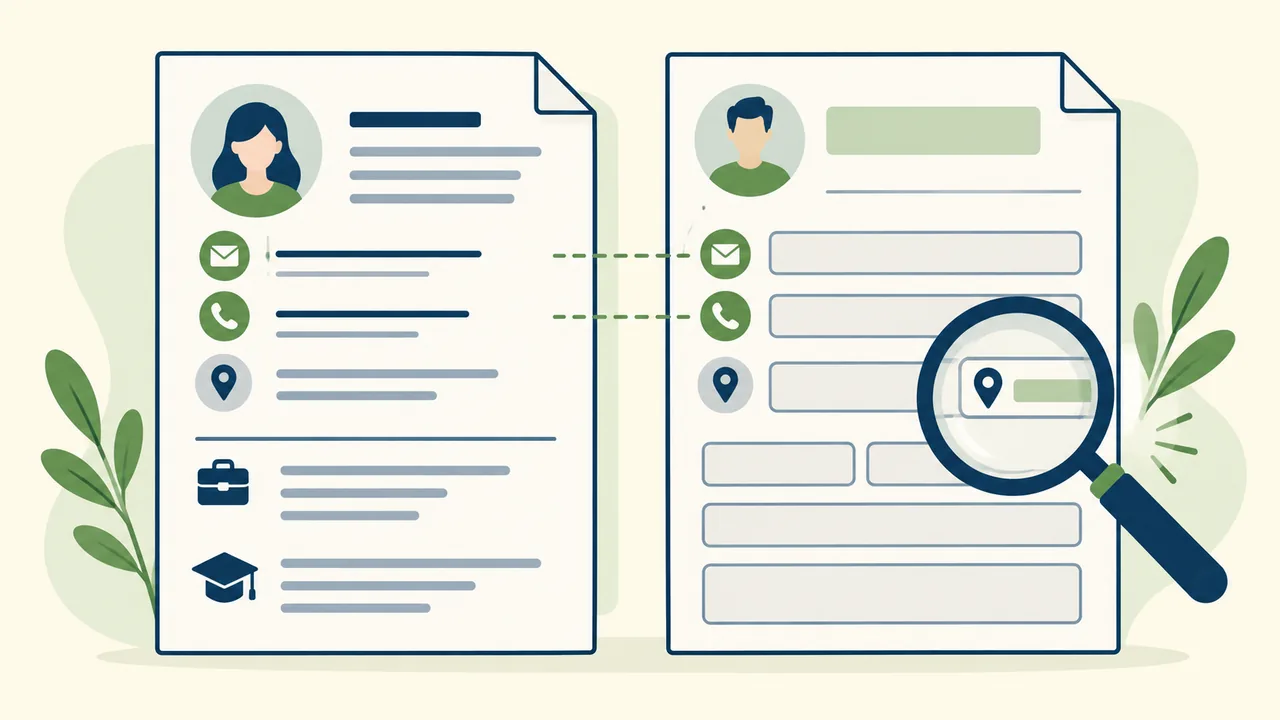
Which contact details should you put on a resume for a remote job?
Include a professional email address you monitor and a reliable phone number if you can receive calls or messages through it. Add a city, region, or country when it clarifies a stated hiring boundary, onsite expectation, or relevant availability. A full street address is usually unnecessary unless the employer requests it or a specific process makes it useful.
Should I put my full address on a remote resume?
Usually, no. A full address is more precise than most remote applications need, and career-service guidance from Penn says applicants do not need to list a full street address. But employer instructions come first. If the job posting or form expressly asks for a mailing or residential address, respond accurately in the requested field.
Should I put my city on a resume if I am applying remotely?
Include your city if it helps explain a relevant condition, such as a local hiring area, occasional office visits, or a relocation plan that you have labeled accurately. If the posting has no location condition and your city does not help the employer understand your application, it can be left off. A broader region or country may be enough when that is the relevant distinction.
Should I include a phone number if the job is remote?
A remote job can still involve phone contact. Include one number if you can reliably receive calls or messages on it and want the employer to use that route. If you cannot monitor a number, do not present it as dependable. Use the application’s required fields and provide an email address you check.
Should I list my time zone on my resume?
Only when it helps answer a real scheduling requirement. If the posting specifies working-hour overlap, respond to that requirement accurately in the application or a concise note. If no overlap is required, a time-zone label is usually unnecessary. Do not claim broad availability you cannot sustain.
What if the application asks for an address but I do not want it on my resume?
Use the application field if the employer clearly requires an address; the resume and form do not have to contain identical levels of detail. If the purpose or wording is unclear, ask the employer what information the field is intended to collect. Do not enter a false address or imply that a mailing address is your current residence if it is not.
What if I am willing to relocate to the job’s location?
Do not list the target city as your current location. If relocation is a genuine plan, label it clearly, such as “Open to relocation to [city],” and qualify it if it depends on an offer or other condition. If your interest is tentative, leave it out of the header and discuss it when the application asks.
If you are ready to make the contact section clear, compare a few layouts in the template gallery, then review the exported PDF and the application form together. The right details are the ones you can verify, the employer can use, and you are comfortable sharing for this application.