How to List Certifications and Licenses on a Resume Accurately
List current, relevant credentials using their official names, issuing organizations, and accurate status. A professional license, a professional certification, and a course-completion certificate are not interchangeable: name each for what it is, and never imply that training or an application has already earned a credential. An in-progress credential can belong on a resume when you label it clearly.

The three credential types are not interchangeable
A license, a professional certification, and a completion certificate tell an employer different things. Use the credential’s official name and category, not the most impressive-sounding label.
A license is an authorization issued by a government authority or regulator. It can be required to practise a regulated profession or perform certain work in a particular place. A professional certification is a credential awarded by an organization after you meet its stated requirements. Those requirements might include an examination, experience, education, or renewal. A completion certificate generally records that you finished a course, training program, or series of classes. It is evidence of learning, not necessarily an independently assessed professional qualification.
The boundaries can vary. Organizations use the words *certificate* and *certification* differently, and local laws determine which credentials authorize particular work. So do not decide what a credential means from its title alone. Read the issuer’s description, the credential rules, and, for a regulated occupation, the relevant regulator’s requirements.
Harvard’s career guidance makes the practical distinction: professional certifications typically have standardized requirements, while certificates often document completion of education or training. It also advises candidates to distinguish relevant certificates from certifications on a resume. (Harvard FAS Mignone Center for Career Success)
Here is a hypothetical comparison:
| Credential | What it generally signals | Resume label |
|---|---|---|
| A state-issued nursing authorization | Permission to practise under the applicable jurisdiction’s rules | License or licensure, with state or jurisdiction and current status |
| A project-management credential awarded after an organization’s requirements are met | A professional credential from a named issuer | Certification, with the issuer and earned status |
| A short online course in spreadsheet basics | Completion of training | Course or training, with the course provider and completion date if useful |
These are examples of categories, not claims about any actual candidate. A credential’s exact rules depend on its issuer and jurisdiction. For instance, New York State says that a person must be licensed and registered by the state to practise or refer to themselves as a registered professional nurse there. That is a jurisdiction-specific legal requirement, not a universal rule for every nursing role or location. (New York State Education Department, RN license requirements)
The best default is to preserve the issuer’s wording. If the issuer calls it a certificate of completion, do not upgrade it to a professional certification. If a regulator calls something a license, do not bury it among unrelated online courses. Clear naming protects your credibility and helps a reader understand what you actually hold.
Which credentials belong on your resume?
Include a credential when it is required, preferred, or clearly relevant to the job you are applying for. Leave off credentials that add no useful evidence for that application, especially when listing them would crowd out stronger experience.
Start with the job posting. Look for required licenses, named certifications, preferred credentials, and alternative qualifications. Then compare each item with what you have actually earned. Harvard’s guidance similarly recommends including relevant credentials and tailoring the selection to the role rather than listing everything indiscriminately. (Harvard FAS Mignone Center for Career Success)
Use this quick test for each item:
- Is it required or preferred? If the job explicitly asks for it and you hold it, make it easy to find.
- Does it support a key duty? A credential can be useful even when the posting does not name it, if it directly supports the work.
- Can you verify the exact name and status? If not, check the issuer before adding it.
- Is it current, expired, suspended, or still in progress? Make the status visible where it matters.
- Would a reader understand what it is? Add the issuer, jurisdiction, credential type, or a short clarifying phrase if the name is ambiguous.
A credential’s relevance is specific to the role. A first-aid certificate may matter for a recreation job and add little to a back-office accounting application. A teaching license may be central to a classroom role, yet irrelevant to a software role unless the position involves education. A course in a tool named in the job posting may help a career changer show recent study, but it does not become proof of professional certification just because the tool is important.
A useful filter is to ask what question the credential answers. Does it show legal authorization? A tested body of professional knowledge? A specific kind of training? If the answer is unclear, the credential may need a better label or may not belong on this version of your resume.
Use a decision table before you add a credential
| Your situation | Include it? | Accurate treatment |
|---|---|---|
| Current license explicitly required for the job | Yes | Put it where it is easy to see; identify jurisdiction and active status if relevant |
| Current certification preferred or strongly related to the work | Usually | Give the official name, issuer, and earned date or current status |
| Relevant certificate from a substantial course or school program | Sometimes | Put it under Education, Training, or a clearly named certificate section; do not call it a professional certification unless that is the issuer’s credential name and meaning |
| Short course with weak connection to the role | Usually not | Omit it or mention it only if it fills a real evidence gap |
| Expired certification with no current relevance | Usually not | Leave it off; if the historical achievement matters, label it expired and explain only when useful |
| Application submitted, decision pending | Do not list as earned | Say “License application pending” only if that status helps and is verifiable; do not imply authorization to practise |
| Credential underway with an expected completion date | Sometimes | Mark In progress or Expected [month year]; include only if relevant and your timeline is credible |
| Exam scheduled but not passed | Usually omit from credentials | If relevant, say “Exam scheduled for [date]” in a truthful context, not “Certified” |
| Attendance badge or participation record | Rarely | Label it as attendance or participation, and include only if the event itself matters |
The strongest exception to “list only earned credentials” is a genuinely relevant credential that is underway. It can be useful evidence of direction and progress, particularly when a role accepts candidates who are still completing the requirement. But mark it unmistakably. “Expected: October 2026” is not the same as “Earned: October 2026.” If the date is uncertain, use “In progress” without predicting a month.
How should you handle licenses?
List a license separately or give it prominent placement when it is required for the role. Use the jurisdiction and status that apply to the actual authorization; passing an exam, graduating from a qualifying program, or submitting an application does not automatically mean you hold an active license.
A resume should help a reader distinguish between being qualified to apply and being authorized to perform regulated work. Use the regulator’s terminology. If the license is active, say so when the status matters. If renewal or registration is separate from the underlying license, follow the regulator’s record and describe the current authorization accurately.
A hypothetical entry might look like this:
Registered Nurse License, New York State Education Department, New York | Active registration through [month year]
This is a format illustration only. It does not describe an actual person or license. Verify the exact title, regulator, and status before using a similar line. Some jurisdictions issue a license and a separate registration, or use other distinctions. New York’s RN requirements page, for example, distinguishes the license from a registration certificate and says the registration must be renewed to continue practising in New York. Do not generalize that specific arrangement to another state or profession. (New York State Education Department, RN license requirements)
If the license has an endorsement, class, scope, or jurisdiction that matters to the job, include it accurately. Do not imply a broader authorization than the record grants. Someone with authorization in one state should not describe it as nationwide unless that is true under applicable rules. Someone with a learner permit or supervised-practice authorization should not label it an unrestricted professional license.
If your status is unclear, verify it before applying. Use the regulator’s official verification service or contact the licensing body. A screenshot, old card, or recollection from a renewal notice may not answer whether the credential is current today. Keep the resume’s claim aligned with the official record, especially when the work is regulated.
License status decision table
| Verified status | Resume wording | Avoid |
|---|---|---|
| Active and applicable | “Active,” if useful, plus issuer or jurisdiction | Leaving out a jurisdiction when it changes the meaning |
| Active in one jurisdiction, applying elsewhere | Name the current jurisdiction; describe an application separately if useful | Implying that an out-of-jurisdiction license already authorizes local practice |
| Renewal submitted but not yet confirmed | State “Renewal pending” only if accurate and relevant | Calling it active before the regulator confirms status |
| Application submitted, approval pending | “License application pending” if it helps explain eligibility | “Licensed,” “registered,” or a post-nominal that suggests approval |
| Limited or supervised authorization | Use the official limited or provisional designation | Presenting limited authorization as an unrestricted license |
| Expired, surrendered, suspended, or revoked | Usually omit; if disclosure is needed, describe status plainly and follow application instructions | Hiding a material status or implying current authorization |
A resume is not a substitute for a regulator’s application or disclosure form. Answer direct questions accurately and follow the employer’s instructions. If a role requires current authorization, do not rely on a vague resume phrase to explain a pending status. State the status plainly and let the employer assess whether it meets the requirement.

How should you handle professional certifications?
Use the full credential name, issuing organization, and a useful date or status. Add a familiar abbreviation only after the full name unless the abbreviation is the clearest official form for the audience.
A straightforward hypothetical entry might look like this:
Project Management Professional (PMP), Project Management Institute | Earned: [month year]
The entry says what the credential is, who awarded it, and when it was earned. If the certification expires or requires renewal, add a current status or expiry date when the employer needs that information. Do not assume a past award proves current standing.
Use the credential holder’s actual name for the organization. A training vendor, course platform, exam proctor, and credential issuer can be different entities. If a class was delivered through one provider but the credential was awarded by another, name the issuer as the issuer. If you mention the course provider, make its role clear.
For instance, if a hypothetical candidate completed a vendor’s preparation course but did not take or pass the certification exam, the resume can say:
Training: Introduction to [subject], [provider] | Completed [month year]
It should not say:
Certified [subject] professional, [provider]
The second line changes a training record into a professional status. That is not a harmless shortcut. It invites a reader to infer that a formal credential was earned.
Check capitalization, punctuation, and the issuer’s current credential name. Credential names change. Some awards have levels or specialties. If you earned a particular level, list that level rather than the umbrella program. If the credential has an acronym that could mean several things, spell it out once.
Certification status decision table
| Status | Better wording | Why |
|---|---|---|
| Earned and current | “Credential Name, Issuer | Earned [month year]” |
| Earned, renewal due | “Credential Name, Issuer | Renewal due [month year]” if useful and verified |
| Renewal submitted, not confirmed | “Renewal pending” only if relevant | Does not overstate current standing |
| Studying, no exam yet | “Credential Name, in progress” if the target role values it | Names an intention, not an earned credential |
| Exam booked | “Exam scheduled [month year]” only if useful | Makes clear the exam has not been passed |
| Exam failed or not passed yet | Usually leave off the certification section; describe current study only if useful | A planned or attempted exam is not an award |
| Lapsed or expired | Usually omit, or label “Expired [year]” if historical relevance justifies inclusion | Prevents a reader from assuming current status |
Certification names and maintenance rules vary by issuer. Check the issuer’s credential directory or official account, not an old resume template or a third-party list. If a credential is central to the job, verify whether it is current before placing it near your name.
When does a course-completion certificate belong?
A course certificate can belong on a resume when the learning is relevant, substantial enough to clarify, or useful evidence for a role you are targeting. Label it as a certificate, course, or training, not as a professional certification unless the issuer actually awards that professional credential.
For many applicants, the best location is the Education section if the program was issued by a school, or a short Training or Professional Development section if it was a focused course. Harvard’s guidance suggests that relevant certificates can sit in Education, especially when a school issued them, or be distinguished from certifications. (Harvard FAS Mignone Center for Career Success)
A completion certificate is stronger when it provides useful context: the subject, provider, date, and, if the title is vague, a short description of the work. It is weaker when it is a generic badge with no clear connection to the role. Do not list every webinar, product demo, and introductory course. A long catalog of small training items can make a resume harder to scan without proving much.
A hypothetical example:
Training: Data Visualization with [Tool], [University or provider] | Completed [month year]
If the course involved a meaningful project, place the project in Projects or Experience and describe what you did. The certificate can support the entry, but it is not a substitute for the work itself. Do not invent a project, exam, grade, number of hours, or performance result to make the course sound stronger.
Use the provider’s official title if it is accurate and understandable. If the title sounds like a degree or license but is actually a short course, add a plain clarifier such as “online course” or “completion certificate.” Clarity matters more than prestige.
Can you list an in-progress credential?
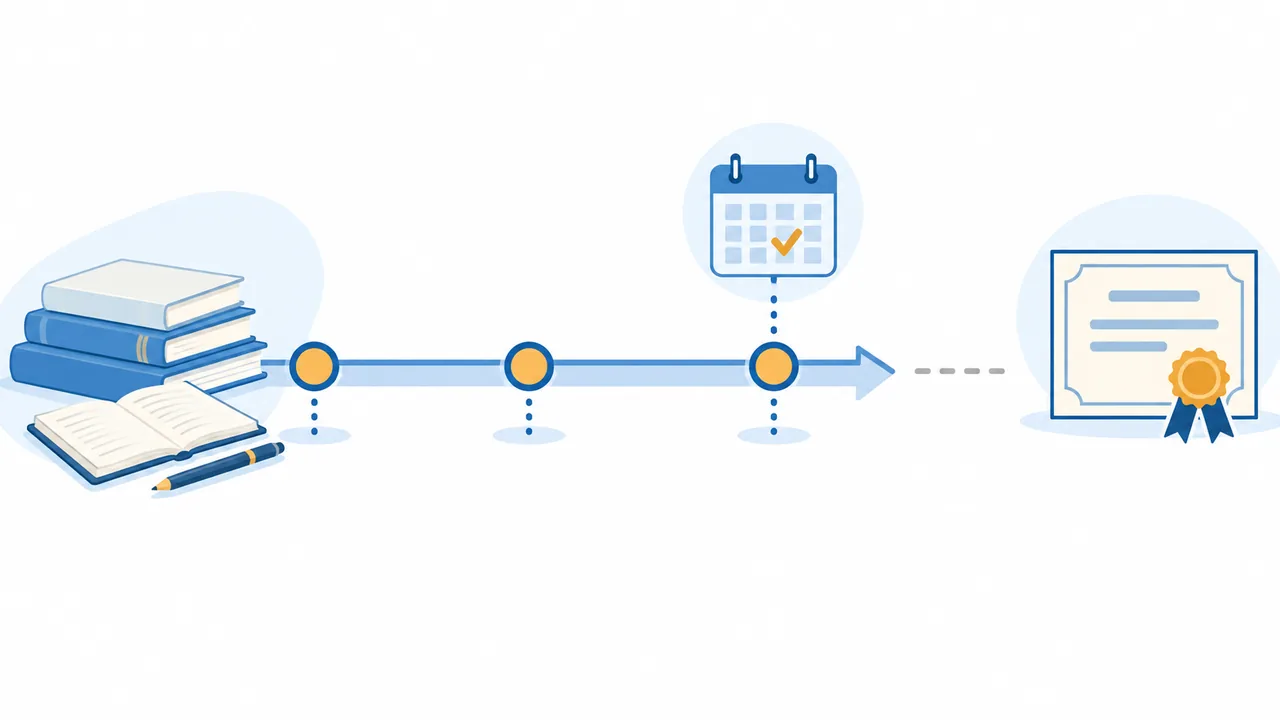
Yes, when it is relevant and clearly marked as unfinished. Use “In progress” or “Expected [month year]” beside the correct credential name, and do not present it as already earned.
The exception is useful because employers sometimes value a candidate’s progress toward a requirement. It is also easy to get wrong. “PMP, 2026” could be read as an earned credential. “PMP certification, in progress; exam planned for [month year]” tells the reader that the candidate is preparing, not certified. Harvard’s guidance recommends labeling a credential as “In Progress” or providing an expected completion date when someone is still working toward it. (Harvard FAS Mignone Center for Career Success)
Use a date only when you have a realistic basis for it. If you are enrolled in a course with a scheduled end date, “Expected [month year]” may be reasonable. If you have not yet met the prerequisites, booked the exam, or decided whether to continue, “In progress” is more honest. If an application is pending with a government regulator, say that instead of implying you have the license.
For a credential with stages, specify the stage you have reached. “Coursework complete; examination pending” is more informative than a broad label that makes the whole qualification seem complete. If you have passed an exam but the issuer has not formally awarded the credential, check whether the issuer permits you to use the credential name. A passing result and an issued credential are not always the same status.
Examples of status wording
The examples below are hypothetical. Replace every bracketed detail with information you have verified.
Still studying:
[Credential name], [issuer] | In progress
Expected completion date:
[Credential name], [issuer] | Expected [month year]
Exam scheduled:
Preparing for [credential name], [issuer] | Exam scheduled [month year]
License application pending:
[License name], [jurisdiction] | Application pending
Use the last two formats only if the status is relevant and true. Do not put an unearned abbreviation after your name. Do not use “candidate” if the issuer reserves that title for a particular stage or membership status you do not hold.
Where should credentials go on the resume?
Put the most important credential where the reader will see it quickly. For many applicants, that means a dedicated Licenses or Certifications section after relevant experience. If a license is a basic eligibility requirement, move it near the top or include it in a short headline without letting the rest of the resume become a credential list.
A useful order depends on the job and your evidence:
- Required license: Place it high enough to answer the eligibility question immediately. A short Licenses section below the contact details or summary can work.
- Relevant certification that supports your experience: Put it in a concise Certifications section, usually after experience or skills.
- Education-based certificate: Put it under Education or Training, where its nature is clear.
- Several credential types: Separate Licenses from Certifications, and separate both from short courses if the distinction helps.
- One minor course: Add it to Education or omit it; do not build a large section around a single weak item.
A new graduate with little paid experience may reasonably move a relevant license or certification higher. A senior applicant with extensive, directly relevant work may keep supporting credentials lower. Harvard’s guidance likewise suggests that a credential section can go near the bottom but may deserve a higher position when it is especially important, such as for an entry-level candidate. (Harvard FAS Mignone Center for Career Success)
Do not use placement to exaggerate. Putting an in-progress credential in a prominent position is fine if the status is unmistakable. Putting an unearned abbreviation beside your name is not. The reader should understand both the credential and its status without having to infer either.
One section or several?
Create separate sections when the distinctions matter to the reader. A nurse applying for a clinical role might need a clear Licenses section and a separate list of relevant certifications. A designer with one short course may not need a separate section at all. A combined “Licenses and Certifications” heading can work when each item is clearly labeled and there are only a few.
Avoid a catch-all “Certifications” heading for a mixed list containing a current license, course attendance, and unfinished exam preparation. That heading can make every line look like the same kind of award. If you combine them for space, label each entry:
License: [Official license name], [jurisdiction] | [verified status]
Certification: [Official credential], [issuer] | Earned [month year]
Course: [Course title], [provider] | Completed [month year]
Those lines are illustrative, not a claim about any candidate. Keep the layout simple enough that a reader can distinguish title, issuer, date, and status at a glance.
What details should each entry include?
For a current, relevant license or certification, include the official name, the issuer or jurisdiction, and a date or status when it helps confirm currency. Add a location, level, specialty, or renewal date only when it changes the meaning or helps the reader assess fit.
A compact entry often has this shape:
[Official credential name], [issuer or jurisdiction] | [earned date or status]
For example, a hypothetical certification entry might read:
[Professional certification], [issuing association] | Earned [month year]
A hypothetical license entry might read:
[Professional license], [state or regulator] | Active [verified date]
A hypothetical course entry might read:
[Course completion certificate], [school or provider] | Completed [month year]
Do not add details just to make the entry look formal. The resume does not usually need a certificate number, full mailing address of the issuer, instructor name, course URL, or every course module. A credential ID may be appropriate in a regulated application or requested by the employer, but avoid publishing private identifiers unnecessarily.
Dates need care. The date you completed training may differ from the award date. A license issue date may differ from the renewal date. If the credential expires, use the current expiry or renewal status only after checking it. If the credential does not expire, an earned date may be enough. Avoid a year-only date when the month materially clarifies current status.
If the credential has a specialty or endorsement, include it only if it is formally awarded or appears on the official record. Do not describe a course topic as a credential specialty. “Studied pediatric care” and “pediatric nursing certification” are different claims.
How do you check that the wording is accurate?
Check the issuer’s record, compare the resume line with the credential’s official name, and make sure the status describes what is true now. Do this before every application where the credential matters.
Use this short verification routine:
- Find the primary record. Open the official issuer, regulator, or credential account. Do not rely only on a third-party course page or an old resume.
- Copy the exact title. Preserve the credential’s name and level. Add an abbreviation only if it is correct and recognizable.
- Identify the awarding body. Separate the training provider from the exam administrator and credential issuer.
- Confirm status. Check whether the credential is active, expired, suspended, pending, or in progress. For licenses, check the relevant jurisdiction’s rules and public verification record where available.
- Check scope. Verify state, country, specialty, endorsement, class, and any restrictions that change what the credential authorizes.
- Choose the right section. Put a license under Licenses, a professional award under Certifications, and a completion record under Education or Training unless a clearer arrangement suits the resume.
- Read the line as a skeptical stranger. Ask what a hiring reader would infer. If they might reasonably think you hold something you do not, rewrite it.
- Recheck the final PDF. Make sure line breaks, dates, and labels remain readable and attached to the correct entry.
Do not present a credential as current because you once held it. Do not present an application as approval. Do not claim a course certificate is a certification simply because a website uses a badge or the word “certified” in marketing copy. Check what the issuer actually awards and what its rules permit you to say.
Accuracy checksheet
Before you send the resume, answer each question:
- Is this credential relevant to this job?
- Is the displayed name the official name, not an embellished paraphrase?
- Have I identified the actual issuer or regulator?
- Have I separated the credential from any preparatory course?
- Does the entry say whether it is earned, current, expired, pending, or in progress when that distinction matters?
- Is the jurisdiction correct, and does the wording avoid implying broader authorization?
- Does the date refer to the event I say it refers to: completion, award, renewal, or expected completion?
- Have I avoided an unearned post-nominal or abbreviation beside my name?
- Would a recruiter understand whether this is a license, certification, or course certificate?
- Can I support every claim with a record, award notice, or course completion record?
If you answer “no” to the last question, pause and verify. A short omission is safer than a confident claim you cannot substantiate.

Common mistakes that change the meaning
The most serious mistake is upgrading a course certificate into a professional certification. The next is leaving off status when a reader could assume a credential is current. Both are avoidable with precise labels.
Calling every course a certification
A course-completion record proves completion of a course. It does not automatically prove a standardized professional qualification, examination, license, or skill level. Use “Course,” “Training,” or “Certificate of completion” when that is what the issuer awards.
Listing an expired credential as current
A credential earned years ago may no longer be valid. If the role requires a current status, an old award date does not answer the question. Renew it, verify it, or label it expired if its history is relevant. Otherwise, leave it off.
Listing an application as a license
Application, education, examination, and authorization are separate milestones. A license application pending with a regulator is not the same as permission to practise. The New York nursing example illustrates why local requirements matter: the state’s published rules specify licensing and registration requirements for practice in New York. Other jurisdictions can use different processes. (New York State Education Department, RN license requirements)
Using a post-nominal you have not earned
Letters after your name can make a credential look official and complete. Use them only if you have earned the qualification and are permitted to use the designation. If the credential is in progress, place that status in the entry instead of attaching the letters to your name.
Treating course attendance as proof of mastery
A participation badge says you attended or completed something, subject to the issuer’s rules. It does not necessarily prove tested competence. If you learned a relevant skill, show evidence of how you used it in a project, role, or practical example. Keep that evidence truthful and distinct from the credential itself.
Hiding the issuer or jurisdiction
A credential title alone can be hard to interpret. Add the issuer or jurisdiction, particularly when several organizations use similar names or a license is geographically limited. Do not expect an acronym to explain itself.
Listing everything you have ever taken
A resume is a targeted document, not a transcript of every training event. Remove low-relevance items before they bury a qualification the posting actually asks for. Harvard’s career guidance makes the same broad point about tailoring credential choices to the job and leaving off irrelevant information. (Harvard FAS Mignone Center for Career Success)
Using a date that promises more than you know
“Expected December” sounds like a real plan. Use it only when you have a reasonable basis for the date. If you are uncertain, write “In progress.” If the exam is merely scheduled, do not write an expected award date as though passing were assured.
How should you handle multiple credentials?
Rank credentials by relevance and current status, then group them by type. Put the required license first, followed by directly relevant certifications, then selective courses if they add something the rest of the resume does not show.
A practical order for a regulated-role application might be:
- Current license required for the job.
- Current specialty certification relevant to the duties.
- Other current professional certifications that support the role.
- Recent, substantial training that fills a genuine gap.
For a nonregulated role, a professional certification that directly supports the work may come first. A course certificate should not outrank strong work evidence just because it is recent. The order should answer the hiring reader’s likely question: “Can this person do the work we need, and what evidence supports that?”
If your list is long, create subheadings or remove items. A well-organized page is better than a dense block of acronyms. Keep related items together, use consistent date formatting, and make current status visible. Do not use a graphic badge or icon as the only indicator of status; the text should carry the meaning.
A simple text layout works:
Licenses [Official license], [jurisdiction] | [status]
Certifications [Official certification], [issuer] | Earned [date]
Training [Course or completion certificate], [provider] | Completed [date]
This is a hypothetical layout, not a required format. If you have only one relevant credential, a compact entry under Education or Skills may be clearer than three empty headings.
What if the job posting uses a different term?
Match the posting’s language only when it accurately describes your credential. If the employer says “certification” but you hold a relevant course-completion certificate, do not relabel it to fit the keyword. State the official title and explain the relationship plainly.
Job postings sometimes use credential terms loosely. A posting may ask for a certificate when it means a course, or use “licensed” informally when the work is not regulated. Check the specific requirement and, when necessary, ask the employer what they accept. Do not infer that your credential meets a legal requirement from similar wording alone.
When the posting names a credential you do not hold, the honest options are limited but useful:
- If you are working toward it, mark it in progress and state the real stage.
- If you hold an equivalent credential, name it accurately and briefly explain the equivalence only if the issuer or employer supports it.
- If you do not hold it, do not put it in a credentials list as though you do. Address related experience elsewhere.
A resume can show that you are close to a qualification. It cannot make a qualification true.
How do you keep the resume readable?
Use a plain text label for each credential and keep the entry short. The reader should be able to identify the name, issuer, and status without decoding a badge, graphic, or unexplained acronym.
A useful template has one line per credential. Keep dates in the same format. Avoid long descriptions unless a brief note resolves an important ambiguity, such as a jurisdiction or a specialty. If a detail takes two lines, make sure it stays visually attached to the credential it describes.
For example, a resume could use:
Licenses
[Official license name], [jurisdiction] | Active, verified [month year]
Certifications
[Official certification name] ([abbreviation]), [issuer] | Earned [month year]
Training
[Course-completion certificate], [provider] | Completed [month year]
All bracketed details are hypothetical. The format is meant to make status visible, not to imply that any specific person holds these credentials.
If you are choosing a layout, use a template that gives headings and dates enough room. A clean visual design cannot fix an inaccurate label, but it can make an accurate one easier to scan. resumetemplate.co offers free resume designs and a free editor; you can compare options in the template gallery or start in the resume editor. Review the final PDF after exporting so the credential heading, status, and date remain clear.
FAQs
Should I list a certificate under Certifications?
Only if the issuer’s credential is actually a professional certification or the wording is clear enough not to imply one. A course-completion certificate usually belongs under Education, Training, or a clearly labeled certificate entry. When in doubt, use the issuer’s exact title and explain that it is a course certificate.
Should I include expired certifications?
Usually not, especially if the job expects a current credential. Include an expired award only when the historical experience is relevant and you label the status plainly. Never let an old award date imply that the credential is active now.
Can I put a certification in progress on my resume?
Yes, if it is relevant and clearly labeled “In progress,” or “Expected [month year]” when that date is realistic. Do not use the completed credential’s post-nominal or write the entry in a way that suggests you already earned it.
Should I list a license number?
Only when the employer, regulator, or application instructions ask for it, or when there is a clear reason to provide it. A resume usually needs the license name, jurisdiction, and relevant status, not a sensitive identifier. Follow the application’s instructions and avoid publishing private information unnecessarily.
Should I put credentials after my name?
Use post-nominals only for credentials you have actually earned and are permitted to use. If the credential is essential to the role, a concise, earned designation may help signal it. Keep an in-progress credential in the body of the resume with an explicit status instead.
What if I completed training but did not pass the exam?
Do not claim the certification. If the training is relevant, list it as training or coursework. If the exam is scheduled and that fact helps the application, say so clearly. Passing a course or completing exam preparation is not the same as receiving the professional credential.
Should I include a certificate from a short online course?
Include it only when it supports the role or fills a real evidence gap. Name the course and provider accurately, and do not let a long list of minor badges crowd out experience, projects, or a more important qualification.
Make the credential easy to trust
A credential line should answer three questions: What is it? Who issued it? What is its status? If a reader has to guess whether it is a license, certification, course certificate, or unfinished goal, rewrite the line.
Start with the role’s actual requirements. Put current, relevant credentials first. Verify the issuer’s wording and status. Separate training from professional awards. Mark unfinished work as unfinished. Then remove anything that does not help explain your fit.
For a final pass, compare your resume with the issuer’s official record and the job posting. If a claim could lead a reader to believe you have authorization or a credential you do not hold, make the distinction explicit. A precise line is stronger than a grander one you cannot defend.